TL;DR:
- Agentic AI moves from pilots to production, embedding task-specific AI agents across enterprise workflows.
- Trust, governance, and transparency become mandatory as AI systems make autonomous decisions.
- Leadership-driven AI strategy replaces fragmented experimentation to deliver measurable ROI.
- Human–AI collaboration reshapes roles, emphasizing AI literacy and orchestration skills.
- Smaller, domain-specific models outperform general-purpose AI while reducing cost and risk.
You’ve probably noticed something shifting. AI isn’t a shiny new toy anymore. It’s becoming the foundation of how businesses actually operate. And 2026 is shaping up to be the year when things get real.
The question isn’t whether your organization should adopt AI. That ship has sailed. The real question is how you’ll implement it, scale it, and make it deliver actual business value instead of just impressive demos.
Let me walk you through the 10 AI trends that will define 2026. These aren’t futuristic predictions. These are changes already happening right now in businesses around the world.
Why 2026 Is AI’s Make or Break Year
Think about where we were just two years ago. AI was mostly about chatbots and simple automation. Fast forward to today, and the landscape looks completely different.
By the end of 2026, 40% of enterprise applications will include task-specific AI agents. [1]That’s not a small shift. That’s a complete transformation of how software works.
But here’s what makes 2026 different from previous years. Organizations are done with experiments that go nowhere. There is little patience for exploratory AI investments, and each dollar spent should fuel measurable outcomes.
You’re not alone if you feel the pressure to show results. Business leaders everywhere are facing the same challenge. How do you move from pilots to production? How do you prove that AI investments actually pay off?
The good news is that success stories are multiplying. We can now see what it looks like when organizations use AI to build leading-edge operating models. And that’s exactly what this article will help you understand.
1. Agentic AI: From Hype to Enterprise Reality
Let’s start with the trend that’s reshaping everything. Agentic AI.
You’ve probably heard the term thrown around. But what does it actually mean for your business?
What Agentic AI Really Means
Agentic AI goes beyond the chatbots and assistants you’re familiar with. These are AI systems that can act independently, make decisions, and handle complex tasks without you micromanaging every step.
Think of the difference this way. Traditional AI waits for you to ask it questions. Agentic AI takes initiative. It sees a problem, evaluates options, and acts on your behalf.
AI agents are set to become digital coworkers, helping individuals and small teams punch above their weight. And the adoption numbers back this up. AI agent adoption jumped from 11% to 42% in just two quarters. [2]
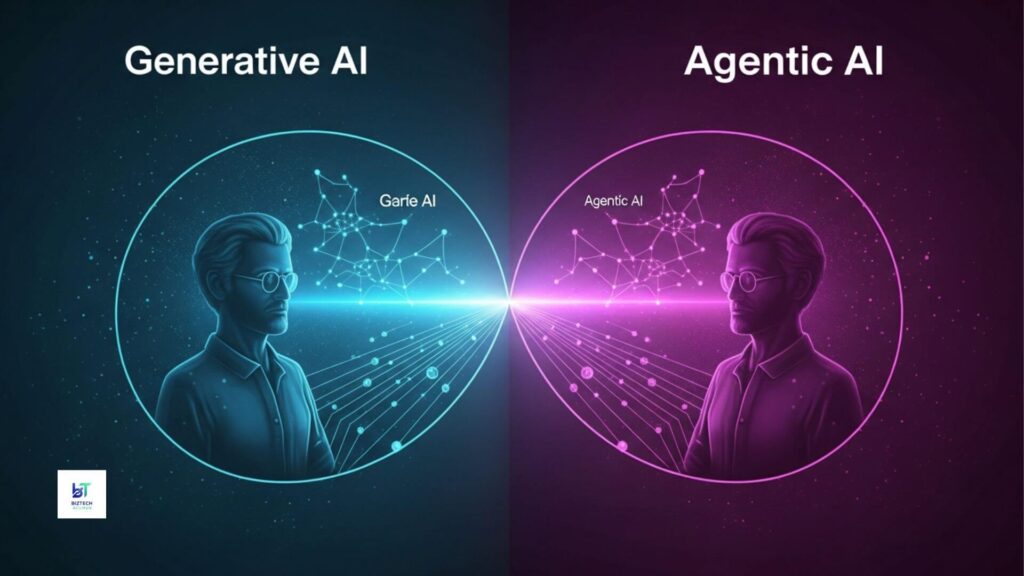
Learn about the difference between generative AI and Agentic AI.
The Market Reality Check
The market is exploding. Industry analysts project the market will surge from $7.8 billion today to over $52 billion by 2030.
But before you get too excited, you need to understand something important. Not every agent works as advertised. Various experiments by vendor and university researchers have found that AI agents make too many mistakes for businesses to rely on them for any process involving big money.
How to Approach Agentic AI Strategically
So what should you do? Start small and focused.
Organizations seeing success with agentic AI aren’t trying to automate everything at once. They’re picking specific workflows where the payoff is clear. By 2030, 45% of organizations will orchestrate AI agents at scale by embedding them across business functions. [3]
The key is starting with well defined use cases in controlled environments. Test thoroughly. Monitor constantly. And scale only when you have proof that it works.
Think about processes that are repetitive, data-heavy, and have clear success criteria. Those are your best candidates for agentic AI.
Check out the top 10 enterprise use cases for Agentic AI
2. Trust Architecture: Building Responsible AI Foundations
Here’s something that might surprise you. The biggest barrier to AI adoption isn’t technology anymore. It’s trust.
Why Governance Isn’t Optional
You need to know exactly how your AI systems make decisions. And more importantly, you need to be able to explain those decisions to regulators, customers, and your own team.
In 2026, trust becomes the defining factor separating experimental AI from operational AI. Organizations that can’t demonstrate trustworthy AI behavior will get left behind.
Boards and executive teams are institutionalizing AI governance as a core competency through continuous learning, proactive oversight, and agile risk management.
What Good Governance Actually Looks Like
Good AI governance isn’t about creating more bureaucracy. It’s about building systems that let you move fast while staying safe.
Organizations must design agents that can show their work for even the most complex outputs. This means every decision your AI makes needs a clear audit trail. You should be able to answer questions like: What data influenced this decision? What logic did the system follow? Where could bias have crept in?
Think of governance as your safety net. It’s what allows you to experiment boldly without risking everything.
Building Continuous Monitoring Systems
Here’s where most organizations get it wrong. They set up governance rules at the beginning and then forget about them. But AI systems drift over time. Data changes. Models adapt. And suddenly, your carefully designed system is behaving differently.
Governance must function as infrastructure with continuous, always on monitoring and management in an automated system.
Set up automated checks that constantly monitor for model drift and bias. Create alerts that flag unusual behavior. And build regular review cycles into your workflow.
The goal is to catch problems before they become crises.
3. Strategic AI: Leadership-Driven Transformation Over Crowdsourcing
Let me tell you about a mistake that’s costing organizations millions.
They let every department experiment with AI on their own. Sounds democratic, right? The problem is, it rarely leads to actual transformation.
The Crowdsourcing Problem
Instead of leadership calling the shots with a top down program, companies take a ground up approach, crowdsourcing initiatives that rarely lead to transformation.
You end up with impressive adoption numbers. Lots of teams using lots of AI tools. But when you look at business outcomes, there’s nothing transformative happening.
Projects don’t align with enterprise priorities. Execution lacks precision. And the whole effort becomes fragmented.
The Top Down Alternative
Here’s what successful organizations do differently. Senior leadership picks the spots for focused AI investments, looking for a few key workflows or business processes where payoffs from AI can be big.
They don’t try to do everything. They identify three to five priority areas. Then they throw serious resources at those areas.
This means dedicated teams. Proper funding. And most importantly, senior leadership attention.
Measuring What Actually Matters
The shift to strategic AI means getting serious about measurement. No more vague promises about productivity improvements. You need hard numbers.
Define clear success metrics before you start. Track them religiously. And be willing to kill projects that aren’t delivering.
AI is no longer the experiment on the side, it’s rewiring how work gets done. That means it deserves the same level of strategic focus as any other major business initiative.
4. The Human AI Partnership: Redefining Roles and Skills
Now let’s talk about the elephant in the room. What happens to your workforce when AI becomes this capable?
Beyond the Automation Narrative
The story you’ve probably heard is simple. AI automates jobs. People lose work. But the reality is more nuanced and, honestly, more interesting.
By 2026, technological advancements will significantly transform the role of human agents, leading organizations to adopt new staffing models.
Notice the word “transform” instead of “replace.” That distinction matters.
Building Change Fitness as a Core Capability
Your employees need more than one time training. The leadership imperative for 2026 is clear: make change fitness a core capability, not an afterthought.
What does that actually mean?
It means creating continuous learning programs that adapt as AI capabilities evolve. It means redesigning workflows, not just individual jobs. And it means rewarding people for learning speed and adaptability.
You need to help your team develop what I call AI orchestration skills. They need to know which tasks to delegate to AI, how to check AI outputs, and when to override AI recommendations.
The Skills That Matter Now
The gap between technical jobs and people jobs is disappearing. Most roles now require a mix of both technical capabilities and human skills.
Your team needs baseline AI literacy. Not everyone needs to be a machine learning expert. But everyone should understand how AI works, what it can and can’t do, and how to use it effectively.
Invest in training programs that focus on practical application. Let people learn by doing. And create safe spaces where they can experiment without fear of failure.
5. Domain Specific AI: The Rise of Efficient, Tailored Models
Here’s a trend that’s flying under the radar but will have huge implications. The move toward smaller, specialized AI models.
Why Smaller Can Be Better
Everyone talks about the big foundation models. But you don’t always need that level of capability. And you definitely don’t always want to pay for it.
Smaller reasoning models that are multimodal and easier to tune for specific domains are becoming increasingly powerful.
These specialized models can often outperform general purpose ones for specific tasks. And they cost a fraction to run.
The Open Source Momentum
Open source AI is accelerating adoption in ways that weren’t possible even a year ago. Organizations can now fine-tune models for their unique use cases without starting from scratch.
This democratizes AI in a real way. You don’t need to be a tech giant with unlimited budgets. Small and mid-sized organizations can build sophisticated AI systems tailored to their specific needs.
Making the Switch
If you’re currently using general-purpose models for everything, it’s time to reassess. Look at your specific use cases. Could a domain-specific model handle them better? Would a smaller model give you adequate performance at a lower cost?
The key is matching the tool to the task. You don’t need a sledgehammer when a regular hammer will do.
6. AI as Research Partner: Accelerating Discovery Across Industries
AI is moving from being a tool to being a genuine research collaborator. And this shift is happening faster than most people realize.
The Evolution in Scientific Research
In 2026, AI won’t just summarize papers, answer questions, and write reports — it will actively join the process of discovery in physics, chemistr,y and biology.
Think about what that means. AI will generate hypotheses, use tools and apps that control scientific experiments, and collaborate with both human and AI research colleagues.
Beyond Academic Research
This isn’t just about universities and research labs. It’s about any industry where innovation matters.
Pharmaceutical companies are using AI to accelerate drug discovery. Materials science companies are finding new compounds faster. Climate researchers are building better models.
The pattern is consistent. AI is compressing the time from hypothesis to validated insight.
Practical Applications for Business
Even if you’re not in a traditional research field, this trend matters. Think about product development. Market research. Competitive analysis. These are all research-intensive activities that AI can accelerate.
The organizations that figure out how to integrate AI into their innovation processes will develop new products faster, identify opportunities sooner, and respond to market changes more quickly.
Start by identifying your most research-intensive processes. Then explore how AI lab assistants could support those functions.
7. Data Sovereignty: Keeping AI Local and Secure
Here’s a trend driven by geopolitics and regulation. Data sovereignty is becoming non-negotiable for many organizations.
Why Location Matters Now
Half of executives worry about overdependence on computing resources in certain regions, a concern that is especially high among business leaders in the Middle East and APAC.
This isn’t just about compliance. It’s about control. Organizations want assurance that their critical data stays where they can control it.
The EU has been leading on data localization requirements. But other regions are following fast. And even without regulation, many organizations are making sovereignty a priority.
The Edge AI Component
Edge AI is the other piece of this puzzle. Instead of sending all your data to centralized cloud servers, you process it locally.
This gives you real time processing with lower latency. It reduces your exposure to network issues. And it keeps sensitive data close to home.
Building Modular Architectures
The solution is designing AI systems that can shift workloads across trusted regions. You need modular architectures that aren’t locked into a single cloud provider or geographic location.
This takes planning. You can’t bolt on sovereignty as an afterthought. It needs to be part of your architecture from the beginning.
Think about where your most sensitive data lives. Where are your biggest regulatory risks? And how can you structure your AI systems to minimize those risks while maintaining performance?
8. Beyond Text: Generative AI in Video, Synthetic Data, and More
Generative AI is evolving way beyond the text generation that made it famous. And the new applications are genuinely impressive.
The Generative Video Revolution
Video generation has reached a tipping point. The quality is good enough for real business use cases. Entertainment companies are using it. Marketing teams are using it. Training departments are using it.
This isn’t about replacing human creators. It’s about augmenting them. You can generate rough drafts faster. Test more variations. And produce content at scale that would have been impossible before.
Synthetic Data’s Growing Role
Here’s an application that doesn’t get enough attention. Synthetic data for training AI models.
You often can’t use real customer data for training because of privacy concerns. Or you don’t have enough examples of rare events. Synthetic data solves both problems.
You can generate realistic training data that looks like your real data but doesn’t contain any actual customer information. And you can create as many examples as you need of edge cases.
Starting Your Generative AI Journey
If you haven’t explored generative AI beyond text, now is the time. Start with pilot projects in marketing or product development.
The technology is mature enough for production use in many scenarios. And the competitive advantages are real for organizations that adopt early.
9. The Next Frontier: AI Meets Quantum Computing
This trend is more forward looking than the others. But you should have it on your radar.
Early Stage Integration
AI and quantum computing are starting to work together. And while we’re still in the early stages, the potential is enormous.
Quantum computers can solve certain types of problems exponentially faster than classical computers. When you combine that with AI, you get capabilities that were science fiction just a few years ago.
Applications in Complex Modeling
The most promising near term applications are in materials research and complex scientific modeling. Problems that involve optimizing across huge numbers of variables are perfect for quantum AI.
Think about drug discovery. Materials science. Climate modeling. Financial risk analysis. These are all areas where quantum AI could deliver breakthroughs.
Future Proofing Your Infrastructure
You’re not going to deploy quantum AI systems tomorrow. But you should be thinking about how your AI infrastructure might need to evolve.
Monitor developments. Understand the potential. And make sure you’re building systems that can adapt as the technology matures.
10. From Experimentation to Measurable Business Value
We’ve covered a lot of trends. But they all come down to this. Making AI deliver real, measurable business value.
The ROI Imperative
There is little patience for exploratory AI investments, and each dollar spent should fuel measurable outcomes.
Your stakeholders want to see results. Not potential. Not promises. Actual results.
That means defining success metrics before you deploy. Tracking them rigorously. And being honest about what’s working and what’s not.
The Maturity Test
Here’s a simple test for whether your AI implementation is mature. Can you demonstrate the AI agent at work? Can you show exactly what value it’s creating?
If you can’t, you’re still in the experimental phase. And that’s fine, as long as you’re honest about it. But don’t confuse experiments with transformation.
AI is no longer the experiment on the side; it’s rewiring how work gets done. That means it needs to deliver business value at the same level as any other core system.
Building Your Success Metrics
Different organizations will measure success differently. But some common metrics include operational efficiency gains, customer experience improvements, and direct financial impact.
Pick metrics that matter to your business. Make sure they’re measurable. And create dashboards that make progress visible to everyone.
The most important thing is defining success clearly upfront. What does winning look like? How will you know when you’ve achieved it?
Preparing Your Organization for AI’s Next Chapter
We’ve covered 10 major AI trends that will shape 2026. But knowing about trends isn’t enough. You need to act.
The Paradigm Shift
The most successful organizations will stop treating AI as a technology race and start treating it as a management revolution.
This is the fundamental insight. AI isn’t just a new tool. It’s a new way of working. And that requires rethinking how you manage, how you organize, and how you make decisions.
Three Immediate Steps
Let me leave you with three concrete actions you can take right now.
First, audit your current AI initiatives. Are they aligned with strategic priorities? Are they delivering measurable value? If not, consolidate and refocus.
Second, invest in your team’s AI literacy. Not through one time training sessions, but through continuous learning programs embedded in daily work.
Third, establish proper governance frameworks. You need the infrastructure to scale AI safely before you try to scale it aggressively.
Looking Forward
2026 is shaping up to be a defining year for AI in business. The organizations that treat this moment seriously, that invest in capabilities rather than just technologies, and that focus on measurable outcomes will build advantages that last for years.
The question isn’t whether AI will transform your industry. It will. The question is whether you’ll lead that transformation or react to it.
The choice is yours. But the window to decide is closing fast.
Stat Reference: