You’ve probably heard about AI everywhere. Your company might even be using chatbots or AI writing assistants. But here’s the problem: most companies aren’t seeing real results from their AI investments.
That’s where agentic AI comes in. Think of it as AI that doesn’t just help you—it actually does the work. These AI agents can figure out what needs to be done, make decisions, and complete entire tasks without you having to guide them through every step. They’re like hiring really smart digital employees who never sleep and can handle complex work on their own.
Let me show you the ten best enterprise use cases for Agentic AI right now, and why it’s finally delivering the results that regular AI couldn’t.
TL;DR
- Agentic AI actually does the work, not just assists you. You set the goal, and autonomous AI agents plan, decide, and complete entire workflows on their own.
- It fixes the AI ROI problem because it automates full business processes (like customer support, sales, IT, and supply chains), not just single tasks.
- The biggest enterprise wins in 2026 are customer service, supply chain, sales & marketing, IT/DevOps, and manufacturing, where agents adapt in real time.
- Companies see real results fast: up to 80% automated issue resolution, 50%+ faster development, lower costs, and higher conversion rates.
- Agentic AI makes businesses more resilient, handling disruptions, exceptions, and changes without breaking or waiting for human input.
- Early adopters gain a lasting advantage by redesigning how work gets done, while late movers risk falling behind competitors building AI-driven operations now.
What Makes Agentic AI Different
You need to understand what sets this apart from the AI tools you’re already using.
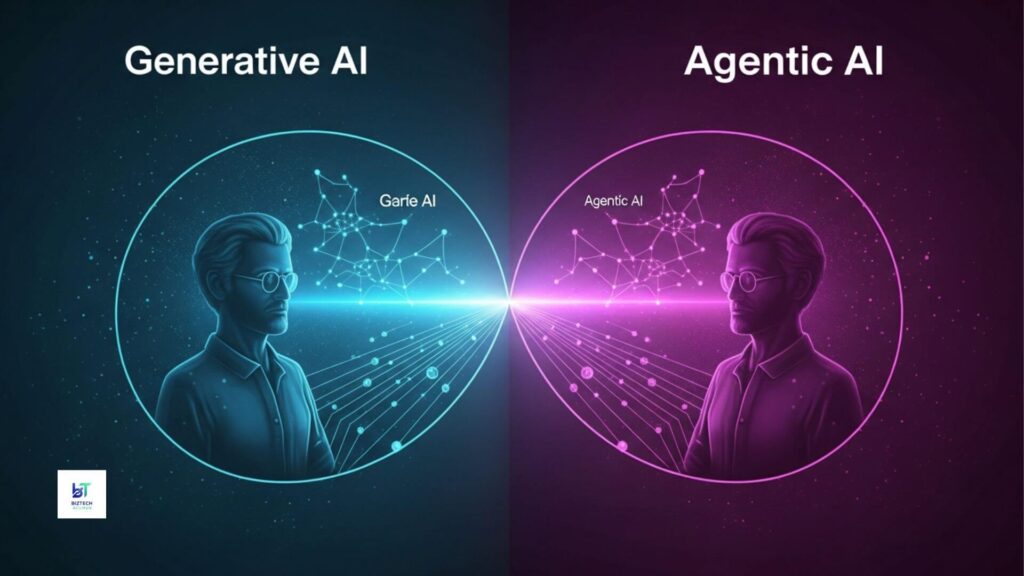
Regular AI follows rules you program into it. Generative AI (like ChatGPT, Claude, Gemini, Perplexity, etc.) creates content when you ask it to. But agentic AI? It takes a goal from you and figures out how to achieve it on its own.
Here’s a simple comparison:
| What It Does | Traditional AI | Generative AI | Agentic AI |
| Main job | Makes predictions | Creates content | Completes tasks |
| How you interact | Follows rules | Answers prompts | You set the goal |
| Makes decisions? | Only what you programmed | Needs your guidance | Yes, independently |
| Handles full workflows? | No, just one step | No, just one step | Yes, start to finish |
| Adapts to changes? | No | A little bit | Yes, constantly |
| Remembers context? | No | Only during your chat | Yes, across everything |
Learn about the difference between Generative AI and Agentic AI from our detailed comparison guide.
Top Enterprise Use Cases for Agentic AI
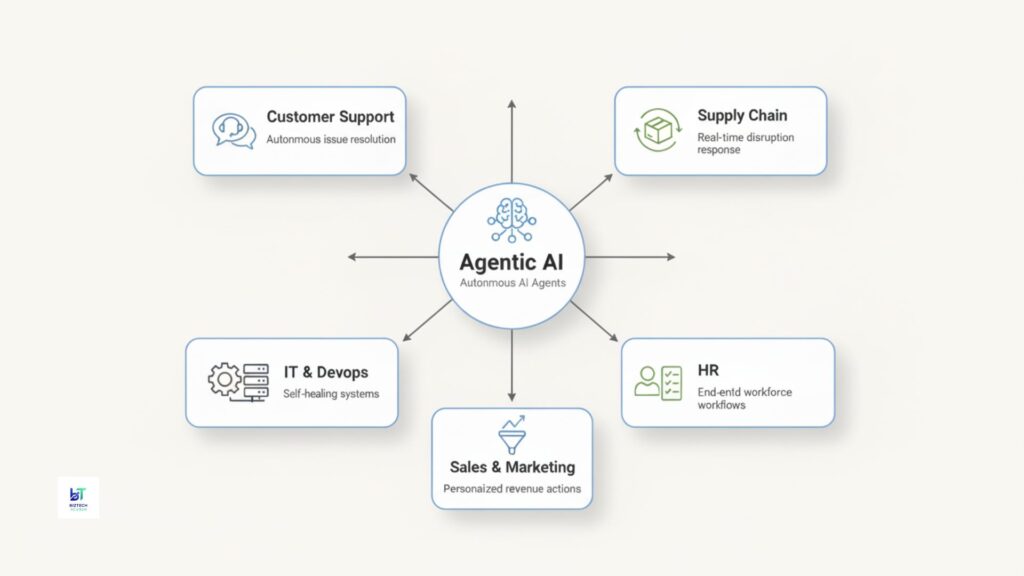
Let me walk you through the ten ways enterprises are using Agentic AI to get real results.
High-Impact Operational Use Cases
Customer Service & Support
Your customer service team probably handles the same problems over and over. An agentic AI system doesn’t just answer questions—it solves the entire problem.
Here’s what happens when a customer contacts you about a delayed package. The AI agent checks the shipping status in real-time, figures out why it’s delayed, looks at your options (refund or rush a replacement), picks the best solution based on your policies, processes it automatically, updates all your systems, and tells the customer what it did—all in seconds, without any human touching it.
📊 What you get: You can resolve 80% of common issues without any human help. Problems that took hours now get fixed in minutes—60-90% faster. Your customers are happier, and your support costs drop significantly.
Supply Chain & Logistics
Your supply chain involves so many moving parts—suppliers, inventory, shipping, delays, weather, all of it. This is exactly where agentic AI shines.
Watch what happens: The AI constantly predicts what you’ll need by looking at your past sales, seasonal patterns, economic trends, and even what people are saying on social media. Based on those predictions, it orders exactly the right amount—not too much, not too little.
When something goes wrong (and something always goes wrong), the AI doesn’t panic. A port closes? The AI finds other suppliers, reroutes your shipments, picks the fastest carriers, handles the pricing negotiations through your systems, and updates everyone involved. What would take your team days happens in minutes.
📊 What you get: Your operations adapt to problems instantly. You spend less on shipping, serve customers better, and reduce your environmental impact through smarter routing.
HR Operations (Hiring, Employee Support, and Workforce Planning)
HR teams spend a huge amount of time coordinating people, paperwork, and policies. Agentic AI takes over that coordination so HR can focus on people, not process.
In hiring, an agentic AI system manages the entire recruitment workflow. It reviews resumes, shortlists candidates based on role requirements, schedules interviews, collects feedback, and moves candidates forward or closes the loop automatically. If a candidate drops out, the AI adjusts the pipeline and fills the gap without HR having to intervene.
Once someone joins, the AI handles onboarding. It sets up accounts, assigns training, tracks completion, answers policy questions, and checks in with new hires proactively. If someone struggles, the agent flags the issue early.
For employee support, the AI becomes a 24/7 HR helpdesk. Employees ask about leave, benefits, payroll, or policies. The agent looks up the rules, applies them correctly, updates systems, and responds instantly. Complex or sensitive cases get escalated with full context.
Workforce planning improves too. The AI analyzes attrition trends, performance data, and business needs to predict hiring gaps before they appear.
📊 What you get: Faster hiring, smoother onboarding, fewer HR tickets, lower attrition risk, and an HR team that spends more time on people and less on admin.
According to a recent research, 47% of HR teams prioritize agentic AI for recruiting, while 33% already use it for resume screening.
Revenue-Driving Use Cases
Sales & Marketing
This is one of the most common enterprise use cases for Agentic AI. You want to reach each customer with the right message at the right time. But doing that manually is impossible at scale. Agentic AI makes it possible.
The AI watches how each customer behaves—what they browse, what they buy, when they shop. Then it delivers personalized offers at exactly the right moment. Not generic recommendations—truly personalized ones based on what it knows about that specific customer right now.
For online stores, the AI sees what’s in someone’s cart, understands the context, and suggests products they’ll actually want. When someone looks ready to buy, it offers an upsell that makes sense. All of this happens automatically and adjusts based on how the customer responds.
In B2B sales, the AI qualifies your leads for you. It looks at company data, how they’ve engaged with you, and whether they fit your ideal customer profile. Then it prioritizes who your sales team should talk to, schedules initial outreach, and even handles first conversations. Your salespeople only get involved when there’s a real opportunity.
📊 What you get: Your conversion rates go up because every customer sees relevant offers. Your sales team works more efficiently because they’re only spending time on qualified leads. And you open up new revenue through smart recommendations.
According to a recent study, 64% of marketing teams and 61% of sales teams increased AI spending recently.
IT & Development Use Cases
IT Operations & DevOps
This is another one of the most widespread enterprise use cases for Agentic AI. Your IT department probably spends tons of time on repetitive work—helping employees with tech problems, writing code, testing software, and managing servers. Agentic AI can handle most of this.
These AI teams document the old code, write new code, review each other’s work for quality and security, put the code together, and test everything. The humans guide the process and make sure quality stays high, but they’re not doing the tedious work anymore.
📊 What you get: The bank cut development time and effort by more than 50%. What would have taken years is happening much faster.
For your helpdesk, AI agents do more than just reset passwords. They diagnose complex problems, figure out solutions, try to fix things themselves, and only bring in a human when they truly need to. The whole time, they’re documenting everything so your knowledge base gets better.
Your development process speeds up too. AI agents write code based on what you need, check code for bugs and security problems, create and run tests, deploy applications, and watch your production systems for issues. This means you can release updates constantly while maintaining quality.
📊 What you get: Development happens 50% faster, your code quality improves, you release features quicker, and you spend less on operations.
Manufacturing
Manufacturing involves coordinating purchasing, production, quality checks, and shipping—so many steps that need to work together. Agentic AI orchestrates all of it.
The AI looks at your orders, available machines, inventory, delivery schedules, and workforce to optimize your production plan. When something goes wrong—a machine breaks, materials run out, priorities change—it automatically reconfigures everything to minimize the damage.
Quality control gets better, too. The AI watches cameras and sensors in real-time, spots defects, triggers fixes, prevents future problems, and keeps records for compliance.
📊 What you get: Less downtime because you fix things before they break, better product quality, smarter use of resources, and fewer production delays.
According to recent findings, 67% of businesses use AI in IT functions, highest among departments.
Key Benefits of Using Agentic AI Across Industries
Let me break down what you actually get when you implement agentic AI across your organization.
You work much faster: Agentic AI can do multiple things at the same time instead of one after another. This parallel processing cuts your cycle times dramatically. Plus, the system scales instantly when you need more capacity.
You adapt to change instantly: Unlike rigid systems that break when something unexpected happens, agentic AI adjusts in real-time. It constantly takes in new information, changes its approach on the fly, reprioritizes based on what’s happening now, and catches problems before they get big. Your operations become smarter and more resilient.
You make better decisions: The AI analyzes massive amounts of data from everywhere at once, spots patterns you’d never see manually, gives you insights right when you need them, and learns from what happens to get better over time. This leads to faster, smarter business decisions across your whole company.
You create new revenue streams: Beyond just working more efficiently, agentic AI lets you build entirely new business models. If you make industrial equipment, you can embed AI agents in your products to offer pay-per-use pricing or performance guarantees. If you’re a service company, you can package your expertise into AI-powered tools and sell them as software. These new offerings create revenue while strengthening customer relationships.
You stay compliant more easily: In regulated industries like finance, healthcare, and legal services, the AI continuously monitors whether you’re following regulations, automatically flags potential violations, generates compliance documentation, and enforces policies consistently. You reduce risk while spending less time on compliance work.
You rethink how work gets done: This might be the biggest benefit, even though it’s the least obvious. Implementing agentic AI forces you to redesign your workflows from scratch. Instead of automating your current (probably inefficient) processes, you have to rethink how work should actually flow. This leads to fundamental improvements in how you operate.
Conclusion
These top enterprise use cases for agentic AI aren’t just small improvements—they represent a fundamental shift in how you can run your business. From customer service that solves problems automatically to supply chains that adapt instantly to disruptions to software that writes itself, AI agents are finally delivering the results that regular AI promised but couldn’t achieve.
The time for testing is over. You need to look at your most important processes, figure out where agentic AI can deliver measurable results, and commit to redesigning how you work. The companies doing this now are building advantages that will be very hard to copy later, while companies that wait will struggle to catch up.
The question isn’t whether this technology will transform how businesses operate. The question is whether you’ll be leading that transformation or scrambling to keep up with competitors who are already building their AI workforces.