TL;DR
- Generative AI creates content (text, images, code) when you prompt it—think ChatGPT or Midjourney. It’s reactive and needs your input for every task.
- Agentic AI takes autonomous action to achieve goals you set. It makes decisions, plans multiple steps, and executes tasks without constant supervision.
- Main difference: creation vs. action. Generative AI assists with creative work. Agentic AI handles entire workflows independently from start to finish.
- Use generative AI for content creation, brainstorming, quick research, and tasks requiring human judgment. It’s easier to implement and shows immediate results.
- Use agentic AI for process automation, 24/7 monitoring, complex multi-system workflows, and repetitive tasks that need decision-making capabilities.
- The future is both working together. Smart businesses use generative AI for creative productivity and agentic AI for operational automation—they complement each other perfectly.
You’ve probably heard about ChatGPT and how it can write essays, create images, or help you code. That’s generative AI in action. But now there’s a new player in town: agentic AI. And trust me, the difference between Generative AI and Agentic AI is bigger than you might think.
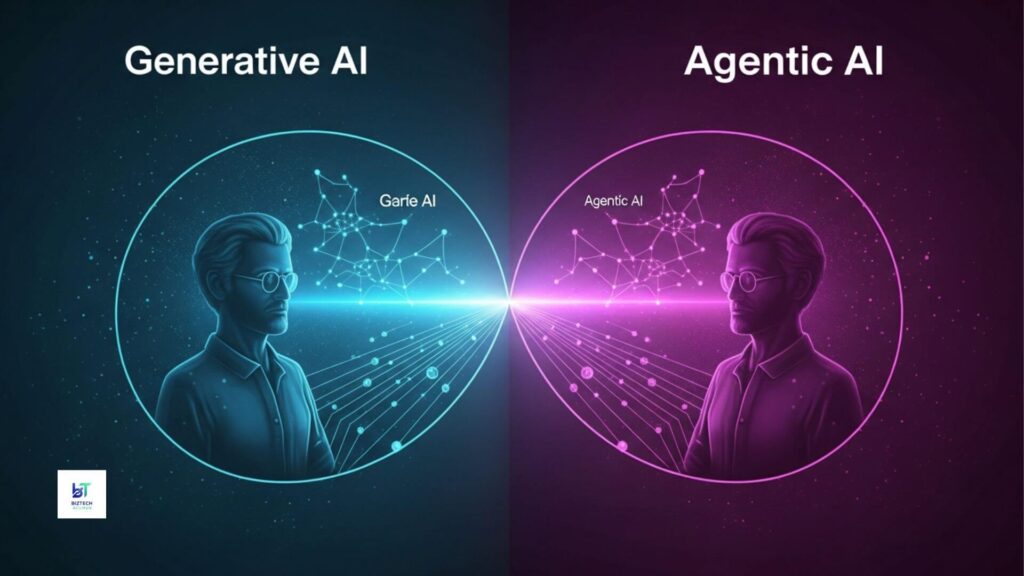
Here’s the simple truth: generative AI creates content when you ask it to. Agentic AI? It takes action and makes decisions on its own to reach a goal. Think of it this way—generative AI is like a super-smart assistant who waits for your instructions. Agentic AI is more like a team member who knows what needs to be done and just does it.
In this guide, I’ll walk you through everything you need to know about both types of AI. You’ll learn what makes them different, when to use each one, and why this matters for your business or projects. Let’s dive in.
What is Generative AI?
Generative AI is artificial intelligence that creates new content from scratch. You give it a prompt, and it generates something for you—text, images, code, music, or even videos.
You’ve probably used generative AI already. When you ask ChatGPT a question, it generates an answer. When you use Midjourney to create artwork, it generates images based on your description. GitHub Copilot writes code for you. All of these are generative AI tools.
Here’s how it works: these systems learn from massive amounts of data. They study patterns in text, images, or code. Then, when you ask them to create something, they predict what should come next based on those patterns. It’s like having someone who’s read every book ever written and can now write in any style you want.
Key characteristics of generative AI:
- Creates content: Its main job is to produce new text, images, or other outputs
- Needs your prompts: It sits quietly until you tell it what to do
- Reacts to requests: It responds to what you ask, nothing more
- Works one task at a time: Each request is separate—it doesn’t remember what it’s working toward
The best part? Generative AI makes content creation faster and easier. Writers overcome writer’s block. Designers create mockups in seconds. Developers write code faster. It’s a powerful tool that boosts your productivity.
But here’s the catch: you’re still in charge of everything. You need to prompt it, check its work, and decide what to do next. It won’t take action on its own or figure out what you need without you telling it.
What is Agentic AI?
Now let’s talk about agentic AI. This is where things get interesting.
Agentic AI doesn’t just create content—it takes action to achieve goals. You give it an objective, and it figures out how to get there. It makes decisions, uses tools, adapts to changes, and keeps working until the job is done. All without you constantly telling it what to do next.
Think about the difference this way: if you tell generative AI to “write a test plan,” it will write one for you. But if you tell agentic AI to “ensure this software works properly,” it will create tests, run them, check the results, fix what’s broken, and keep testing until everything passes.
Key characteristics of agentic AI:
- Pursues goals: It focuses on achieving specific objectives
- Makes decisions: It chooses the best path forward on its own
- Takes action: It doesn’t just suggest—it actually does things
- Plans multiple steps: It breaks big goals into smaller tasks and executes them
- Adapts to change: When something doesn’t work, it tries a different approach
- Works continuously: It keeps going until it reaches the goal
Real-world examples help explain this better. In software testing, agentic AI doesn’t just generate test cases. It runs them, spots problems, fixes itself when the software changes, and reports back only when it needs human input. In supply chains, it monitors everything, predicts problems, adjusts routes, and manages inventory automatically.
The key word here is “autonomous.” Agentic AI has agency—it can act independently. That’s where the name comes from.
Core Differences: Agentic AI vs Generative AI
Let me break down the main differences in a way that’s easy to understand.
Difference Between Generative AI and Agentic AI: Fundamental Characteristics
| Feature | Generative AI | Agentic AI |
| Primary Purpose | Creates content (text, images, code) | Achieves goals through action |
| Autonomy Level | Low – needs constant human prompts | High – operates independently |
| Human Interaction | Required for every task | Only needed for goal setting and oversight |
| Decision Making | None – follows instructions only | Makes independent choices |
| Workflow Type | Single-turn (one request, one response) | Multi-step (plans and executes complex tasks) |
| Behavior | Reactive – waits for you | Proactive – identifies and acts on opportunities |
Difference Between Generative AI and Agentic AI: Practical Comparison
| Aspect | Generative AI | Agentic AI |
| Best Use Cases | Writing, design, brainstorming, coding help | Process automation, testing, monitoring, optimization |
| Main Strength | Creative output and speed | Autonomous execution and persistence |
| Biggest Limitation | Can’t verify or act on its outputs | More complex to set up and monitor |
| Implementation | Easy – often just API access | More involved – requires integration |
| Typical Cost | Lower upfront, pay per use | Higher initial setup, scales better |
| ROI Timeline | Immediate productivity gains | Longer-term operational transformation |
Now let me explain what these differences actually mean for you.
Purpose and behavior: Generative AI waits for your command like a helpful assistant. You ask, it answers. Agentic AI acts more like a colleague with a to-do list. Give it a goal, and it figures out the rest.
Decision-making ability: This is huge. Generative AI doesn’t decide anything—it just does what you ask. Agentic AI evaluates options, picks the best approach, and adjusts if something goes wrong. If a test fails, it doesn’t just report the failure. It tries to figure out why and might even fix the problem itself.
Workflow complexity: With generative AI, you’re conducting every step. Write an email, review it, edit it, send it. With agentic AI, you set the objective (like “improve customer response time”) and it handles everything—analyzing current performance, identifying bottlenecks, implementing fixes, measuring results.
Need for supervision: Generative AI needs you watching every output. You check for accuracy, quality, and relevance. Agentic AI works more independently. You set boundaries and goals, then it operates within those parameters. You only step in when it hits something truly unusual or needs human judgment.
Here’s a practical example: imagine you need to test a website after an update.
With generative AI, you’d ask it to write test cases. It gives you a list. Then you manually run those tests, check results, and fix any issues. It helps, but you’re doing most of the work.
With agentic AI, you’d say “test this website and make sure everything works.” It creates tests, runs them across different browsers, finds bugs, updates tests when the site changes, and alerts you only if it finds critical issues. It handles the entire process.
See the difference? One is a tool you use. The other is a system that works alongside you.
When to Use Each Technology
So which one do you need? It depends on what you’re trying to accomplish.
Use Generative AI When You Need:
Content creation at scale: If you’re writing blog posts, creating marketing copy, or designing visuals, generative AI is perfect. It gives you a starting point or even finished drafts that you can refine.
Quick answers and research: Need to understand a topic fast? Want to explore different ideas? Generative AI excels at synthesizing information and explaining concepts.
Creative exploration: When you’re brainstorming or trying different approaches, generative AI helps you see possibilities you might not have considered.
Human judgment is critical: For anything requiring your expertise, taste, or decision-making, generative AI provides options while you stay in control.
Simple implementation: You can start using tools like ChatGPT or Claude today. No complex setup required.
Use Agentic AI When You Need:
Process automation: If you have repetitive tasks that follow clear rules but require some decision-making, agentic AI can handle them completely.
24/7 operation: Systems that need constant monitoring—like security, testing, or infrastructure management—benefit from agentic AI’s tireless operation.
Complex workflows: When work spans multiple systems and requires coordination, agentic AI orchestrates everything smoothly.
Goal-oriented outcomes: If you care more about achieving a result than controlling every step, agentic AI delivers. You define success, and it finds the way there.
Scale and consistency: Agentic AI performs the same way every time, learning and improving without getting tired or making human errors.
Industry Applications: Real-World Examples
Let me show you how both types of AI work in real situations.
In software development: Generative AI helps developers write code faster with tools like GitHub Copilot. But agentic AI manages entire testing pipelines—creating tests, running them, maintaining them as code changes, and ensuring quality without human intervention.
In customer service: Generative AI powers chatbots that answer common questions. Agentic AI takes this further—it doesn’t just answer, it resolves issues by accessing systems, processing returns, updating accounts, and following up to ensure satisfaction.
In marketing: Generative AI creates ad copy, social posts, and email campaigns. Agentic AI analyzes campaign performance, adjusts budgets, tests different audiences, and optimizes for conversions automatically.
In finance: Generative AI helps analysts by creating reports and summarizing data. Agentic AI actively manages portfolios, executes trades based on market conditions, and rebalances investments to meet goals.
In healthcare: Generative AI assists with documentation and patient communications. Agentic AI monitors patient data, predicts health issues before they become serious, schedules interventions, and coordinates care across providers.
In manufacturing: Generative AI designs product variations and optimizes layouts. Agentic AI manages entire production lines, predicting maintenance needs, ordering parts before they run out, and adjusting workflows based on demand.
The pattern is clear: generative AI assists humans with creative and analytical tasks. Agentic AI takes over entire processes and drives outcomes independently.
The Future: Why You’ll Use Both
Here’s the thing—you don’t have to choose just one. The future belongs to smart combinations of both technologies.
Many advanced systems already blend generative and agentic AI. An agentic system might use generative AI to create reports, draft communications, or explain its decisions. Meanwhile, it’s autonomously managing complex workflows behind the scenes.
Think of it like this: agentic AI is the project manager who keeps everything moving forward. Generative AI is the creative specialist it calls on when content needs to be created. Together, they’re more powerful than either alone.
What’s coming next:
You’ll see specialized AI agents that focus on specific jobs—one for testing, another for security, another for customer support. They’ll work together like a digital team.
These agents will get better at explaining their decisions and learning from feedback. The line between “AI that creates” and “AI that acts” will blur as systems combine both capabilities seamlessly.
For businesses, this means starting with generative AI for quick wins, then gradually adding agentic capabilities for processes that benefit from automation. You don’t need to transform everything overnight.
Key Takeaways
Let me wrap up the difference between Generative AI and Agentic AI with the essentials:
Generative AI creates content when you ask. It’s reactive, needs your prompts, and excels at creative and analytical tasks. Use it when you want to speed up content creation, get quick answers, or explore ideas.
Agentic AI achieves goals autonomously. It’s proactive, makes decisions, and handles complex workflows from start to finish. Use it when you want processes to run themselves, need 24/7 operation, or want to focus on strategy while AI handles execution.
The main difference is action. Generative AI suggests and creates. Agentic AI decides and executes. One assists you. The other works independently toward goals you set.
You’ll probably use both. They complement each other perfectly. Let generative AI boost your productivity on creative tasks. Let agentic AI handle repetitive processes and complex automation.
Start where it makes sense. If you’re new to AI, begin with generative tools—they’re easier to implement and show immediate value. As you get comfortable, explore agentic solutions for processes that drain your team’s time.
The world of AI is moving fast. Understanding the difference between generative AI and agentic AI helps you make smart decisions about which tools to use and when. Both are powerful. Both have their place. The key is knowing what you’re trying to accomplish and picking the right AI for the job.
Now you know the difference. The question is: which one will you try first?
Frequently Asked Questions
FAQ 1: Is ChatGPT generative AI or agentic AI?
ChatGPT is generative AI. It creates content based on your prompts but doesn’t take actions or make decisions on its own. It waits for you to ask questions and responds with text. It can’t autonomously pursue goals or execute tasks across multiple systems without your input at each step.
FAQ 2: Can agentic AI replace generative AI?
No, they serve different purposes. Agentic AI excels at autonomous task execution and goal achievement, while generative AI specializes in content creation. Most businesses benefit from using both—generative AI for creative work and quick answers, agentic AI for process automation and complex workflows. They complement rather than replace each other.
FAQ 3: Which is more expensive to implement—generative AI or agentic AI?
Generative AI typically costs less upfront. You can access tools like ChatGPT immediately with subscription or API fees. Agentic AI requires more initial investment for setup, integration with existing systems, and configuration. However, agentic AI often delivers better long-term ROI by automating entire processes and scaling operations without additional human resources.
FAQ 4: What are the main risks of using agentic AI?
The biggest risks include autonomous errors that cascade through systems before detection, security vulnerabilities from broader system access, and accountability challenges when AI makes independent decisions. That’s why proper boundaries, monitoring, and human oversight for critical decisions remain essential. Start with low-risk processes and expand gradually as you build confidence.